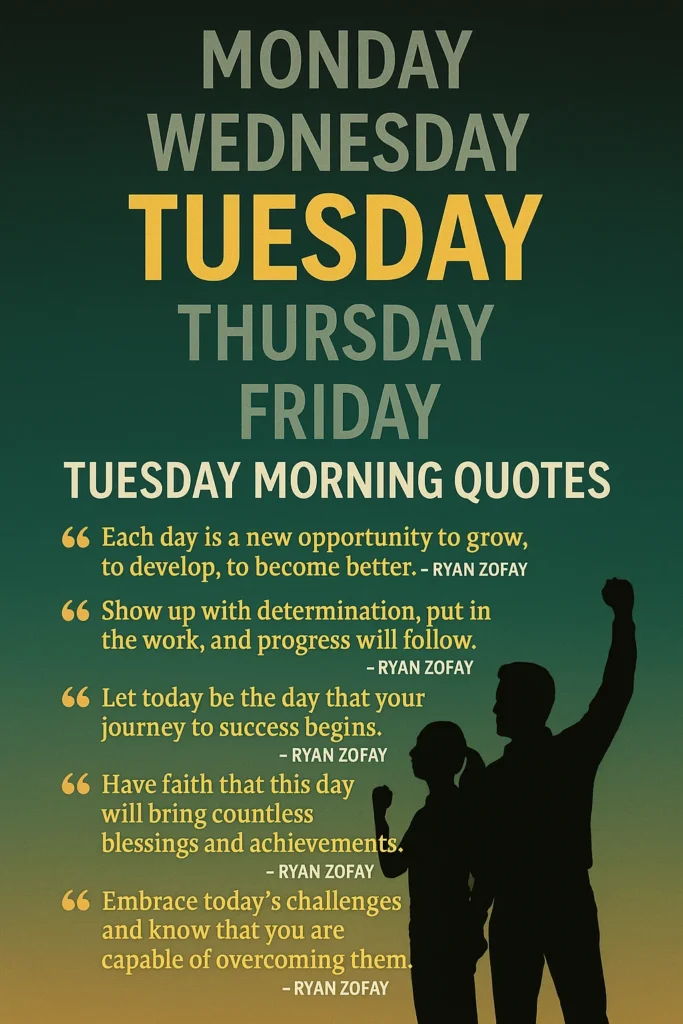
Tuesday Morning Quotes
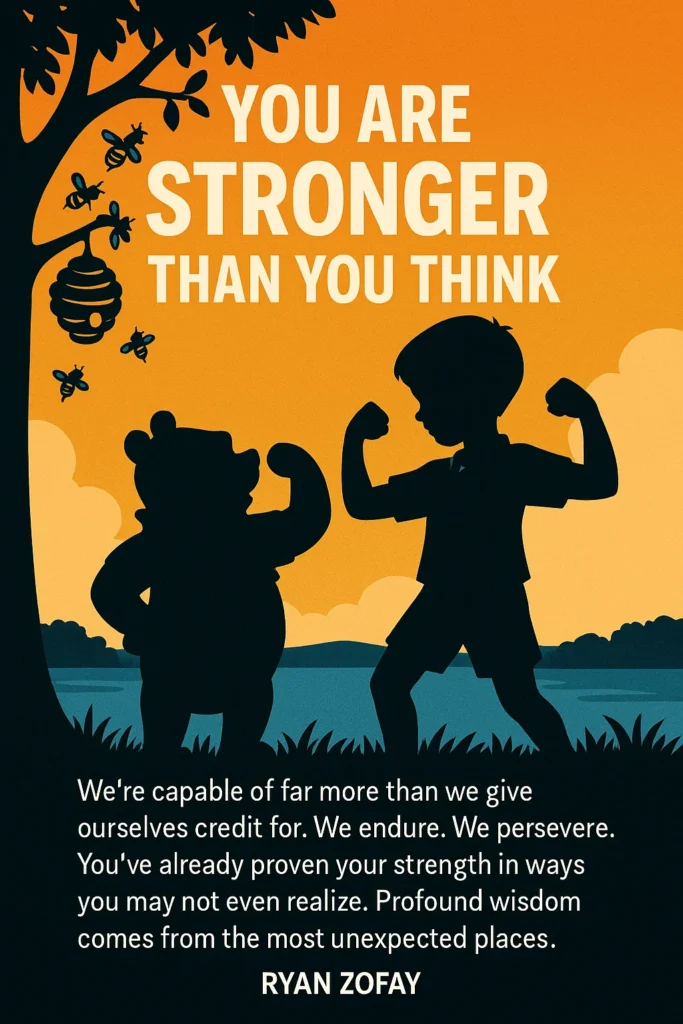
Tuesday Morning Quotes: Why You Are Stronger Than You Think
Every week, I receive messages from people. They ask how to change their mindset when they wake up feeling stuck, tired, or overwhelmed. Maybe you’ve even asked yourself recently, “Why do I hate my life?”
I want to slow down right here and talk to you like I’m talking to a client sitting across from me. If you woke up heavy today—mentally, emotionally, spiritually—there’s nothing “wrong” with you. It usually means you’ve been carrying too much, too long, with too little recovery.
I’ve been there. And I want to remind you of something important: you are stronger than you think.
On Tuesday mornings especially, people feel that “in-between” energy. Monday hit hard. The week is still long. And your brain starts whispering: “This is going to be the same week again.” That’s exactly why I treat Tuesday like a reset point—not a grind day. A recalibration day.
On mornings when I need a push, I start with happy Tuesday morning quotes—not because words alone change everything, but because they act like keys. They unlock a different perspective, one that can lead to action, passion, and eventually transformation.
Here’s the difference I coach people to understand: a quote isn’t “motivation.” A quote is a command—if you attach it to behavior. Words become powerful when they trigger a choice.
My Tuesday rule: I don’t wait to “feel” strong. I do something small that proves I’m strong. Then my feelings catch up to my behavior.
Why Your Brain Responds to Inspiration
Research indicates that the words we consume can impact our mood, decision-making, and even our resilience. Neuroscientists call it neuroplasticity: the brain’s ability to rewire itself based on repeated thought patterns.
This means that when you start your mornings with affirmations, gratitude, or positive quotes, you are not just “feeling good.” You are training your brain to build new pathways of strength and optimism.
Let me make this practical. Your brain is a prediction machine. It tries to conserve energy by running the same mental scripts every day:
-
“I’m behind.”
-
“I’m not enough.”
-
“Nothing changes.”
When those scripts repeat, your body responds like it’s under threat—tight chest, shallow breathing, racing thoughts, low patience. That’s not weakness. That’s physiology.
Science-based coaching insight: your nervous system doesn’t respond to “what’s true.” It responds to what it perceives as urgent or threatening. Words can change perception. Perception changes physiology. Physiology changes behavior.
A quick brain stat that matters: your brain uses a huge portion of your daily energy budget. When you wake up stressed, your brain is already spending energy “protecting” you. That’s why you feel tired before you even start. Inspiration—used correctly—reduces mental chaos and gives your brain a clear target.
The Tuesday Morning Rewire (3 minutes):
-
Read one quote that hits you in the chest (not the one that sounds cute).
-
Write one sentence: “Today I choose ________ over ________.” (Example: “I choose progress over perfection.”)
-
Take one action within 60 seconds (drink water, make the bed, step outside, send the email, start the task).
Mini-checklist: Signs your mindset is drifting into “default mode”
-
You keep reaching for your phone without thinking.
-
You’re re-living yesterday or pre-living problems that haven’t happened yet.
-
You feel busy but you’re not producing outcomes.
-
You’re waiting to “feel ready.”
Reset script (say it out loud): “My brain is trying to protect me, not lead me. I lead. I choose one small win right now.”
Living Your Best Life Now
So how do we move from inspiration into action? The answer lies in alignment. When you identify what matters most and structure your daily actions around it, you begin to live your best life now.
Here’s what “alignment” really means in coaching terms: your values, your calendar, and your behavior all match. If your values say “health,” but your calendar says “chaos,” you’ll feel off. If your values say “growth,” but your behavior says “avoidance,” you’ll feel stuck.
But here’s the trap I see too many people fall into: they wait for passion to appear like lightning. The truth is, passion is built through consistency. If you want something to be passionate about, you have to show up for it, again and again, even when motivation feels low.
Let me give you a real example. I’ve coached people who said, “I don’t know my purpose.” But when we looked at their week, they were spending their best hours on distractions and their leftovers on their dreams. That’s not a purpose problem. That’s a structure problem.
Alignment exercise (10 minutes):
-
Write your top 3 priorities (examples: mental health, career growth, family, fitness, recovery, spiritual life).
-
Circle the one you’re avoiding. Be honest.
-
Write the smallest daily action that proves it matters (10 minutes counts).
Mini-checklist: Tuesday Alignment Questions
-
What do I want to feel at the end of today?
-
What is the one task that removes the most stress?
-
What would “my best life now” version of me do first?
-
What boundary do I need to set today (time, people, habits, screens)?
Coach script for building passion: “I don’t need passion first. I need consistency first. Passion is the reward for showing up.”

End-of-section takeaway (expanded): Alignment is not a vibe. It’s a system. When your actions match your values, your confidence grows. When your confidence grows, you stop asking “What’s wrong with me?” and you start asking “What’s my next move?”
Exercises I Practice Daily
Here are a few simple activities I personally use and recommend:
-
The Gratitude Shift – Each morning, write down one thing you’re grateful for and one thing you’re proud of from yesterday. This creates a small, positive feedback loop.
-
The 5-Minute Breath Reset – Research shows breathwork lowers cortisol (your stress hormone). Before diving into work, I take 5 minutes to focus only on my breath. It instantly calms and clears my mind.
-
The Time Audit – Download a time management sheet template and spend one day tracking where your hours actually go. Most people find they “lose” 1–3 hours daily on distractions they didn’t even notice. Awareness is the first step to taking your time back.
Now I’m going to expand these like I would if we were doing a coaching session, because the magic is in the details.
1) The Gratitude Shift (upgrade):
-
Write one gratitude that is specific: a person, a moment, a second chance, a small win.
-
Write one pride point: something you did even when you didn’t feel like it.
-
Write one forward move: “Today I will earn my confidence by ________.”
2) The 5-Minute Breath Reset (step-by-step):
-
Inhale through your nose for a slow count.
-
Exhale longer than you inhale (this is key for calming your system).
-
Drop your shoulders. Relax your jaw. Unclench your hands.
-
On each exhale, repeat: “I’m safe. I’m present. I’m capable.”
3) The Time Audit (what you’re really measuring): You’re not measuring time. You’re measuring attention. Most people don’t have a time problem—they have an attention leak. The audit shows you where your focus is getting stolen.
Mini-checklist: Tuesday “Stronger Than You Think” routine (20 minutes total)
-
2 minutes: gratitude + pride point
-
5 minutes: breath reset
-
10 minutes: first work sprint (the task you’re avoiding)
-
3 minutes: write the one quote you’re using today and the action it triggers
Action script (when you don’t feel like it): “I’m not here to feel motivated. I’m here to build momentum. Momentum builds motivation.”
End-of-section takeaway (expanded): These exercises aren’t about being perfect. They’re about building proof. Proof that you can regulate your mind, protect your time, and choose one disciplined action even on a hard morning.
The Bigger Vision: Changing the World
At the heart of all this personal work is a bigger question: What do I want to give back?
For me, the answer has always been: “I would like to change the world for the better by helping people transform their pain into purpose.
Let me tell you something I believe deeply: most people don’t need more information. They need more belief in themselves, and a structure that keeps them moving when life gets loud.
And here’s the truth—you don’t have to change the whole world today. Start with one conversation. One act of kindness. One commitment to yourself that you actually keep. Small ripples create waves.
My “change the world” checklist (simple and real):
-
Change your morning, change your day.
-
Change your day, change your week.
-
Change your week, change your habits.
-
Change your habits, change your identity.
Service script (when you feel stuck in your own head): “Who can I help today in a small way?” Helping someone else is one of the fastest ways to get your brain out of a negative loop.
End-of-section takeaway (expanded): Purpose isn’t found in one giant moment. It’s built through small commitments that you keep. When you keep promises to yourself, you become the kind of person who can keep promises to the world.
Final Thought
If you woke up this morning asking yourself tough questions, remember this: you are so much stronger than you think. Pair that strength with intention, consistent habits, and a clear vision, and your life can shift faster than you imagine.
So start today. Pick one quote. One exercise. One choice that aligns with your best life. Then repeat it tomorrow. Transformation isn’t about doing everything at once—it’s about doing something that matters, over and over again.
Here’s my Tuesday challenge for you (do it today):
-
Write one quote you need this morning.
-
Write the action it triggers (one sentence).
-
Do that action within the next 30 minutes.
-
Tonight: write one win you earned and one thing you’ll repeat tomorrow.
My final coaching reminder: Strength isn’t the absence of struggle. Strength is showing up anyway. Strength is doing the next right thing even when you feel tired. That’s what makes you dangerous—in the best way.
👉 Which of these exercises resonates with you most? Would you like me to expand a full weekly practice guide for Tuesdays?


Comments
Post a Comment